Your Website Needs an AI Assistant That Actually Knows Your Products
At AHTD’s fall meeting in Carlsbad, a speaker declared that AI had killed the distributor website. More customers are asking ChatGPT for product recommendations before they open a browser. Industrial parts, though, are a difficult place to leave the decision to a general-purpose AI.
Imagine a maintenance manager dealing with a failed drive on a packaging line. The original model is discontinued. ChatGPT suggests a replacement and gives a part number. Before ordering, the manager needs to know whether it works with the existing motor, controls and installation. That’s where an experienced distributor earns its keep.
Now the manager visits your website. There’s a product page, a few PDFs and a contact form. They can call an application engineer during business hours. Your team’s knowledge of substitutions, accessories and compatibility is valuable, but little of it is available on the site.
Customers are getting used to asking questions in plain English and receiving answers immediately. We should expect them to ask the same of distributor websites.
We tested the general-purpose models
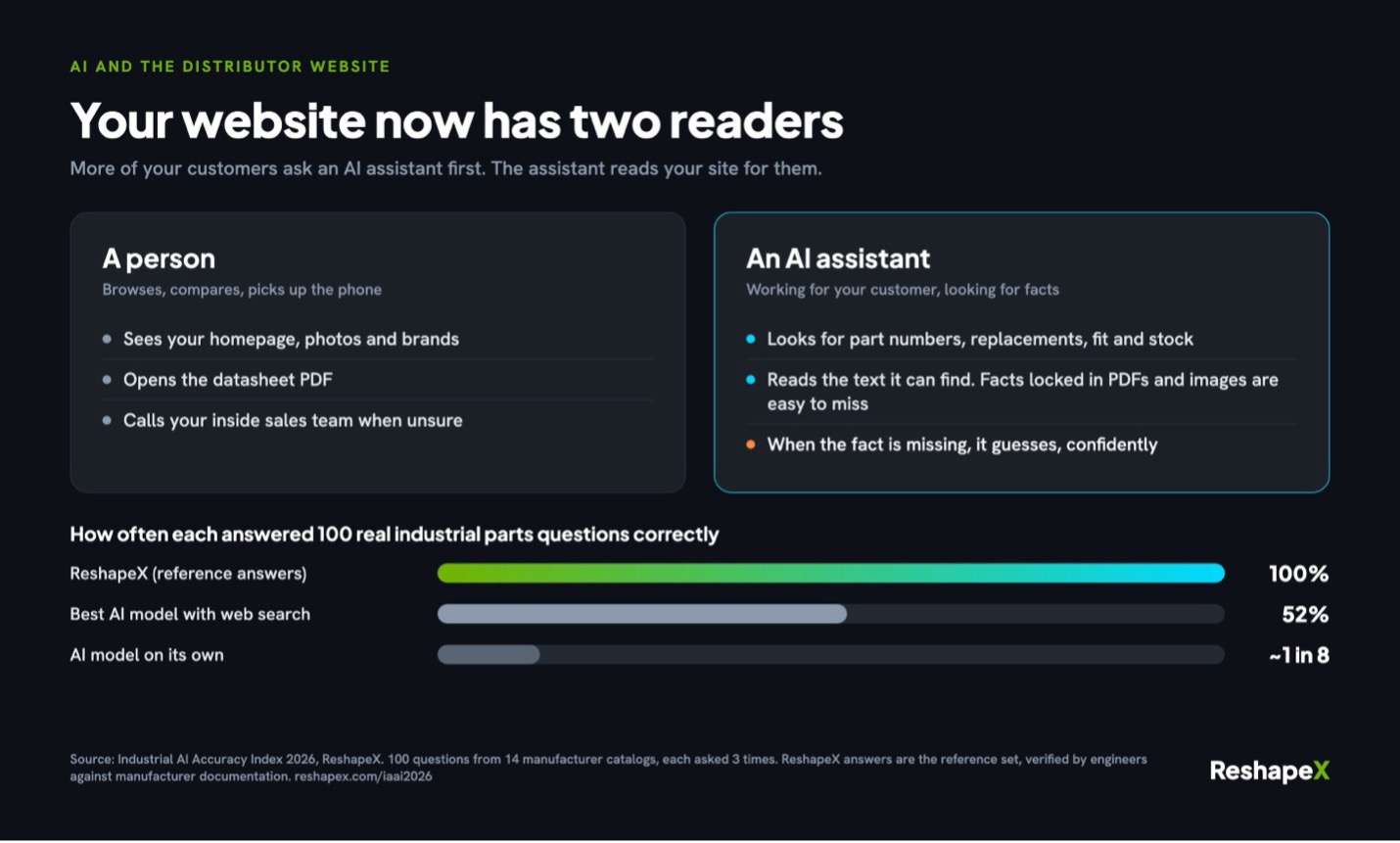
For the Industrial AI Accuracy Index, our engineers prepared 100 questions from 14 manufacturer catalogs, covering replacements, compatibility, specifications and product status. We asked leading AI models each question three times.
Without web search, they got roughly one answer in eight right. With web search, the best model reached 52 percent. It’s a specific test, but enough to make me cautious about AI-generated product recommendations. Wrong answers can look convincing. A customer may discover the mistake only after the part arrives.
The full Industrial AI Accuracy Index, with all 100 questions, is at reshapex.com/iaai2026.
What your team knows
Your best inside salespeople and application engineers already know how to handle these questions. They know when a manufacturer’s suggested replacement needs an extra accessory, which alternatives work in the field, and what to ask before promising a substitute. That knowledge is scattered across catalogs, ERP records, old quotes, support emails and the people everyone calls with difficult questions.
Getting that information into an AI assistant takes more than uploading PDFs. Product variants matter. Documents get superseded. A catalog may list a successor without explaining the conditions under which it will work. Your engineers need to help verify the answers and decide when the assistant should ask for more information or involve a person.
What a useful website assistant looks like
Suppose that maintenance manager types the old drive number into an assistant on your site. Instead of sending back a list of search results, it asks about the voltage, motor and control interface. It identifies a replacement supported by your technical documentation, explains the relevant differences and links to the sources. If it can’t establish compatibility, it says so and passes the details to your team.
If connected to current business systems, that same assistant can help with stock, lead times or a quote. It can also help inside sales and newer employees.
At ReshapeX, we organize and verify industrial product knowledge so distributors and manufacturers can use it in AI assistants. Their experts help decide which answers are reliable.
Try five questions
Take five technical questions customers asked last week and ask ChatGPT to answer them. Have an application engineer check the results. Then try finding those answers on your website, without calling anyone. Note which documents and people you needed along the way.
You now have a useful starting point for evaluating a website assistant. Ask a provider to handle those five questions with your own information. Include one where the answer depends on a detail the customer hasn’t supplied. See whether the assistant asks or guesses.
Your website still has a job to do. It should give customers access to more of the expertise they come to your company for.
Next month: What if customers never visit your site? I’ll look at how distributors appear in ChatGPT’s answers, ways to improve AI search visibility, and how buyers’ AI agents may eventually talk directly to your own.
Juan Aparicio is CEO and co-founder of Reshape Automation, which builds AI agents that automate tedious technical and commercial work for industrial distributors, OEMs, and manufacturers. Grounded in each company's own product data, the agents handle customer service, application engineering, inside sales, and field maintenance with the accuracy industrial work demands.
 Contact
Juan Aparicio
CEO
Reshape Automation
juan@reshapeautomation.com
Monday, October 26, 2026
by: Juan Aparicio
Section: Press Releases



